

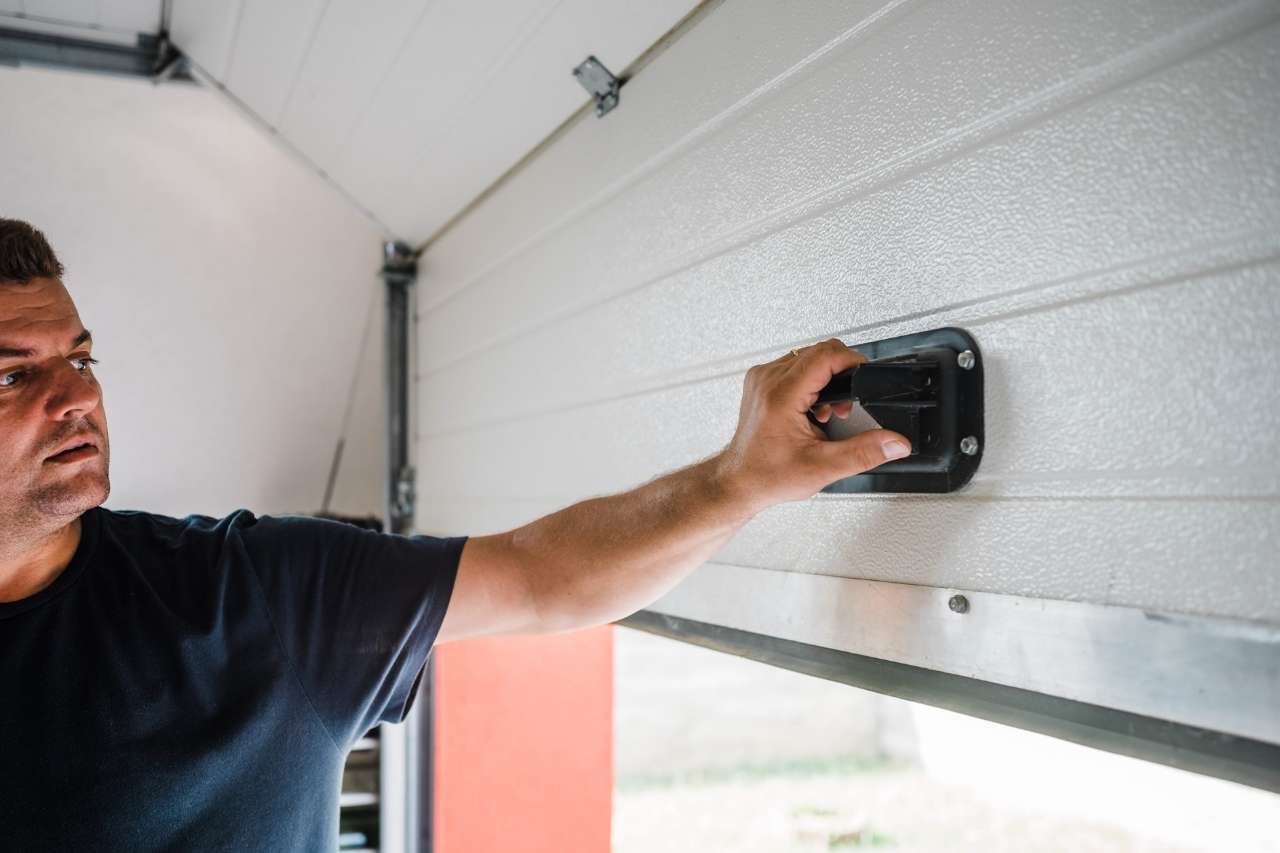
In this article, we will go through how many turns on a garage door spring so you’ll have an understanding of when heading to repair them. With a weight of 400+ lbs, the carport gate is the heaviest moveable fixture in your household. When the gate goes upward and forth, typically with a vehicle or a passenger below as it rises, we place our confidence in the runners, rails, and springs.
The part that does most of the activity is a spring, which accomplishes that amid many lbs of torsion. However, these springy may easily break, leaving the door impenetrable and confining a vehicle within or beyond the driveway.
When the fasteners of the springs get strained, the individual fixing the springs is under the influence of torque. This procedure could be daunting to a newbie DIY restorer.
Read more about torsional springs and their twists.
The most popular form of carport opening mechanism is a flexible torsional arrangement. As the gate gets down, wires connected to the base corners of the gate induce the coils to sweep up, and this twisty produces preserved energy. The springs relax whenever the gate gets raised, and the power assists lift the carport gate.
There is no set rule for how frequently springs can make due. However, if you got an extremely hefty carport door, the springs might tear out following only three years. You may inspect the springs directly for evidence that they are deteriorating. If you discover spaces within the springy curls, they might require modification. Let’s look at how many turns on a garage door spring.
How Many Turns On A Garage Door Spring?
A spring guideline is four quarter turns to approach a full insurgency. The spring ought to sort out a total bombshell for each foot of entrance stature. How much turn gets expected on your springs relies upon the tallness of your carport entryway.
If your entrance is 7ft high, we suggest going at 31 Quarter turns each spring. If you have an 8ft entryway, begin at 34 Quarter turns. You would need to fix the agent a full go clockwise to add pressure if the entrance shuts effectively without holding down midway. Notwithstanding, you will need to release the agent three turns counterclockwise if it is excessively close.
Note: Whenever you take a gander at the fixed or winding cone, you might recognize a number, for example, 2.0 or 1.75. Assuming you see the previous, the spring has a 2-inch width. The other significant estimate of your carport spring is its general length.
Carport entryway springs can get fixed by a mortgage holder. Generally, security rules get kept, and the spring maker takes the legitimate advances as expected. Becoming familiar with how many turns on a garage door spring, utilizing a winding bar, and taking care of the springs’ twist.
Depending on the situation, it will consider adjusting, changing, and fixing without calling a maintenance organization and acclimating to their timetable.
What Are Dome Lights In A Car And How To Replace Car Dome Lights? Here is our tutorial.
Fix new springs
While buying another spring, estimations from the old spring should get taken to guarantee the appropriate substitution gets utilized. Purchasing any spring can bring about an entryway flying open from excess twists or crashing down from close to nothing.
The estimations that should get taken incorporate the distance across the current spring and the length and the wire size. One technique for remembering the number of turns that get completed is to paint a line down the width of the spring. As the spring arrives at its fixing point, there will be 7.5 holes set apart in the paint.
Wind the spring
Utilize the winding bars upwards to fix as opposed to slackening the spring. Place a twisting bar at the base and bring it ¼ turn up. Place the subsequent twisted bar in the winding cone space present at the bottom, then, at that point, eliminate the primary bar. Complete this interaction for the necessary measure of turns.
Fix the Set Screws
Pull the wrapping bar up a little and fix the set screws ¾ of a turn past close. Complete the fixing system on the spring on the opposite side of the carport.
Note: While supplanting pressure springs, it gets suggested that the two springs get substituted and matched. Because the more established, solid spring will have lost a portion of its strain from long purpose stretches. It supplants the two springs assists with adjusting the entryway. Hence, it opens flawlessly with equivalent power applied to each side of the entrance.
In addition, springs that are too small san make the opener less effective. Assuming the spring for the entryway is tiny, it can make the entry excessively weighty. Whenever somebody attempts to raise the entrance, it will fall instead of proceeding to lift. A person ignorant about the carport entryway issue could get injured by the entryway falling shut.
Maneuvers
The time has come to look at the work with the two springs fixed. Eliminate the terrible habit of grasping on the shaft and lifting the entryway midway. The entryway ought to remain set up any place it is situated. Assuming it is excessively weighty, a twist should get added. Two different things to check: Is there link strain when the entryway is up? How far does the entry rise when it gets lifted?
Also, it must be flush with the entrance as over-go adds additional pressure to the spring and diminishes the life expectancy. These can get fixed by one or the other by winding or loosening up the springs or, at times, buying an alternate size of spring.
Bottom line
So, there will generally be a similar number of transformations of the springs on your old carport entryway. 31 quarter spins for a 2.7m high entrance and 34 quarter turns for a 2.40m high entryway. The typical carport entryway spring, if accurately introduced, should go on around 10,000 patterns of opening and shutting.

