

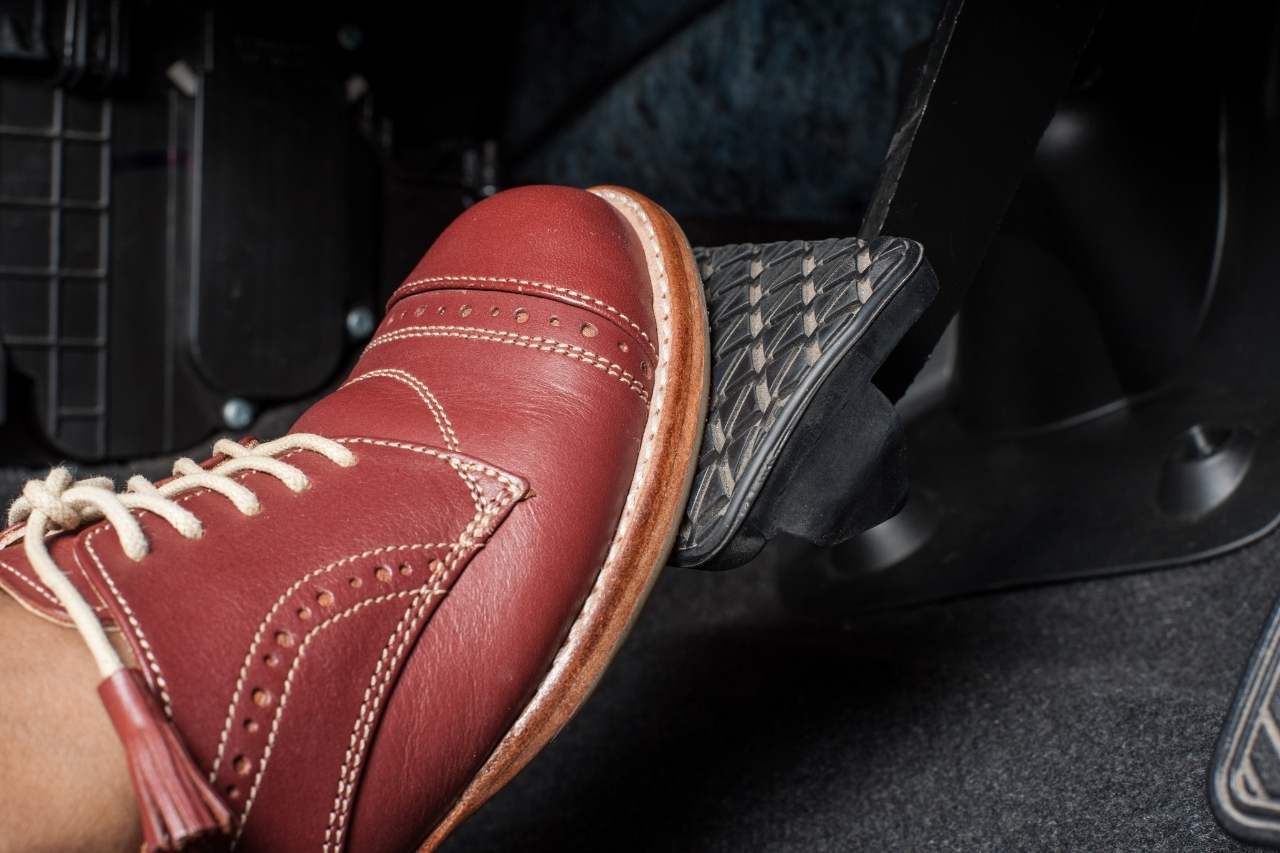
When referring to vehicles, you may overlook many little problems, but concerns with brakes must never be overlooked. If the brake pedal goes to floor when engine running, you must be highly cautious. If you notice that your brake pedal goes all the way down when engine running, have your car examined as early as possible. Continuing to drive your automobile if you encounter something similar is strongly discouraged.
How Would Vehicle Brakes Act?
We must first look through how the braking system works to understand why the brake pedal goes to floor when engine running.
Whenever you push the brake, you produce compression, which the cylinder converts to hydraulic pressure. A master cylinder pushes the braking fluid so far towards your brakes. This hydraulic mechanism converts the power exerted by the foot on a brake couple of extra pressure to hit the brakes and bring the vehicle to a complete halt.
The braking fluid exerts hydraulic pressure upon its piston, compressing the internal brake pad & subsequently pushing the external paddle to the brake disc. The disc rotor will be clamped by the brake discs, which will cause this to slow due to the force. It drags the vehicle down by causing the tires to descend simultaneously.
We could talk about why the brake pedal goes to floor when engine running because now you understand the braking function.
Why Does The Brake Pedal Goes To Floor When Engine Running?
Here are possible reasons if your brake goes all the way to the floor when the engine is on.
-
Brake fluid
If you push the brake pedal when there has been a fluid leak, all brake fluid will spill out. As you press the brake again, it would instead take in airflow through its leak, making the pedal incredibly marshy.
Its braking pads slide and compress into the braking rotor due to the high pressure of such brake fluid. As an outcome, your brake pedal goes to floor when engine running, and the automobile either does not stop or makes a tiny slowdown.
-
Master Cylinder for the Brakes
Since the brake pedal is linked to a master cylinder through a piston rod, this should feel strong beneath your foot. The master brake cylinder’s job is to transfer brake fluid towards the caliper pistons to slow down the vehicle. Its pushing piston of the master brake cylinder was sealed.
Whenever you push the brake pedal, the braking pressure may return to the opposite side of the device if a sealing begins to leak. If you push the brake pedal, this will reduce pressure, giving you the sensation of a sunken brake.
How Far Can You Drive On A Flat Tire? Don’t GUESS IT.
-
Booster for the brakes
Whereas if the brake pedal goes to floor when engine running and the vehicle still brakes, the brake power booster may have broken. We are still not receiving the necessary power boost to bring the automobile to a complete stop.
Among the master cylinder as well as the brake pedal would be a brake booster, which is attached to the engine. Once you press the brake pedal, a brake booster employs pressure to amplify the brake’s power.
This implies that we do not even need to use a lot of force to bring the automobile to a halt. One will observe an increase in braking distance if the braking booster is malfunctioning.
-
Brake Lines
Several drivers have claimed that after replacing the cylinder, the brake pedal goes to floor when engine running. This might be the case if you recently rebuilt something like that in your car’s hydraulic braking system without adequately bleeding the brakes afterward.
This is possible for air to enter the braking system if brake fluid levels are too low. It isn’t enough to replace the brake fluid if it’s that little as the air got into the system. You must bleed the braking system one more.
Air may be compressed. So, the braking system must be entirely free of air to create pressure and quickly avoid a soggy brake pedal.
How To Stop Brake Pedal Going All The way Down When Engine Running?
How can you solve your brake pedal goes to floor when engine running?
Once the brake pedal goes to floor when engine running, the very first assumption that jumps to mind is that there must be a leak in one of the brake systems. Look for symptoms of brake fluid leakage throughout your vehicle, and replace the leaking component.
Check the gasoline level regularly to ensure that the brake pedal is stable. Inspect the brake fluid level since the exhaust headers reservoir and replace it. Verify the brake liquid level inside the plastic bottle to ensure adequate.
Its brake master cylinder, which has several seals to keep the oil inside closed, is just the next thing to examine. Disconnect the master brake cylinder and look for every evidence of seal deterioration.
This component is the most common source of engine leaks, enabling the pedal to drop to the floor while the engine is running. It is vital to remove the brake cylinder. Brake lines that have failed are dangerous. As a result, as long as the brake pedal goes to floor when engine running, you should inspect this component.
Why Does My Car Smell Like Gas? We Have Found The REASON.
While The Engine Begins Must The Brake Be Dropped?
Your pedal should fall an inch on the floor if a vacuuming booster is working correctly. The brake must feel somewhat firm once it has stopped lowering.
Final Thoughts
It is highly unsafe to operate a car if the brake pedal goes to floor when engine running. A precise diagnosis is the most effective way to solve this problem. The best course of action is to avoid driving the automobile and thoroughly inspect it to determine the exact cause.
Hopefully, the previous essay has given you a better understanding of why the brake pedal goes to floor when engine running and how to solve it correctly. The situation of the brake pedal goes to floor when these suggested methods should solve engine running. If you’re still not sure what’s wrong, get the vehicle evaluated by an expert.

